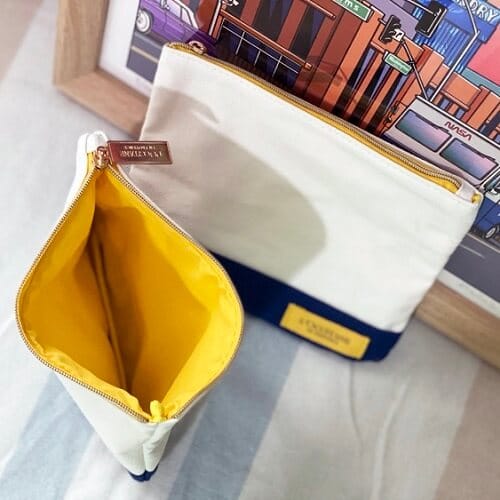
Eco-Friendly Custom Pouches Singapore: RPET, Organic Canvas & GRS-Certified Options for Sustainable Brands (2026)
Singapore’s corporate procurement landscape has shifted. Green-label requirements in government tenders, mandatory ESG disclosure under SGX listing rules, and employee expectations of ethically sourced merchandise have pushed sustainability from a “nice to have” to a line item on the purchase checklist. Custom pouches — one of the most versatile and highest-retention branded gifts — are now available in a range of eco-certified materials. This guide explains what each option actually means, what certifications to look for, and how to source responsibly in Singapore.
At a glance: Aquaholic offers eco-friendly customizable pouches in RPET, organic cotton canvas, non-woven recycled fabric, and GRS-certified nylon. MOQ 300 pcs. ESG Scope 3 documentation available on request. Browse all customised pouch Singapore options.
Why Eco-Friendly Custom Pouches Matter for Singapore Brands
Three regulatory and market forces are driving the shift to sustainable branded merchandise in Singapore:
SGX ESG Reporting
Listed companies must report Scope 3 emissions, which include purchased goods. Branded merchandise sourced from GRS-certified suppliers helps document responsible procurement.
GeBIZ Green Procurement
Government tenders increasingly award points for sustainable materials. RPET and organic cotton pouches can be cited in sustainability declarations during GeBIZ quotation submissions.
Employee & Client Expectations
A 2024 Deloitte survey found 69% of Singapore Gen Z employees prefer to work for companies with visible sustainability commitments. Eco-branded gifts signal values alignment.
Beyond compliance, there is a practical argument: eco pouches made from RPET and organic canvas are genuinely more durable and retain their appearance longer than their virgin-material equivalents, which means better brand impressions over a longer lifespan.
Eco-Friendly Pouch Materials Explained
RPET (Recycled Polyethylene Terephthalate)
RPET fabric is woven from yarn spun out of post-consumer PET bottles — typically clear water bottles sorted, cleaned, chipped, and extruded into fibre. The resulting fabric looks and handles similarly to conventional polyester but diverts plastic from landfills and the ocean.
- Typical bottle reduction: A standard 20×30 cm RPET pouch uses approximately 3–5 post-consumer PET bottles.
- GRS certification: Look for Global Recycled Standard (GRS) certification on both the fabric and the finished product — this verifies the recycled content claim through an independent audit chain.
- Printability: RPET polyester takes sublimation printing (full-colour all-over) and heat transfer extremely well. Silkscreen is also possible on flat panels.
- Price premium: Expect a 15–25% premium over conventional polyester at the same weight and construction, slightly less at quantities above 2,000 pcs.
- Best for: Corporate giveaways, F&B brand GWP bags, wellness event kits, school activity pouches.
Organic Cotton Canvas
Organic cotton canvas is grown without synthetic pesticides or fertilisers, certified under GOTS (Global Organic Textile Standard) or OCS (Organic Content Standard). It is the eco upgrade of the most popular pouch material in the Aquaholic range — the familiar 10 oz canvas.
- Look and feel: Nearly identical to conventional canvas; slightly softer hand after washing. No visual compromise on branding.
- Certification options: GOTS (most stringent — covers fibre, dyeing, and manufacturing social standards); OCS (certifies organic content only, easier to source at scale).
- Printability: Silkscreen and embroidery perform identically to conventional canvas. DTF and heat transfer also work well.
- Price premium: 20–35% above standard canvas for GOTS-certified; 10–20% for OCS-certified.
- Best for: Premium corporate gifts, eco-brand retail GWP, staff welcome kits, hospitality amenity pouches.
Recycled Non-Woven (RPET Non-Woven)
Standard non-woven bags and pouches are made from virgin polypropylene — a plastic polymer that is not biodegradable. Recycled non-woven substitutes RPET spunbond fabric in place of virgin PP, keeping the low unit cost and familiar feel while meaningfully reducing the virgin plastic footprint.
- Cost position: Usually only 8–15% more expensive than virgin non-woven — the most affordable eco upgrade available.
- Printability: Silkscreen, as with conventional non-woven. Full-colour offset printing on laminated versions.
- Best for: High-volume budget giveaways where eco credentials are important but unit cost must remain low. Suitable for mass events (1,000+ pcs) and community club distributions.
Jute (Natural Fibre)
Jute is a natural bast fibre that is fully biodegradable and requires minimal pesticide use to grow. While more commonly seen in tote bags, jute can be constructed into zippered flat pouches and cosmetic pouches, often with a cotton canvas lining for a cleaner interior finish.
- Aesthetic: Textured, natural look — signals eco credentials visibly. Popular with artisan brands, organic food companies, and wellness retailers.
- Printability: Silkscreen on flat jute surface; embroidery possible on lined versions.
- Limitations: Less water-resistant; not suitable for toiletry or cosmetic use without waterproof lining.
Eco Material Comparison at a Glance
| Material | Eco claim | Key certification | Price vs standard | MOQ 300 pcs? |
|---|---|---|---|---|
| RPET polyester | Post-consumer recycled | GRS | +15–25% | ✓ |
| Organic cotton canvas | No synthetic pesticides | GOTS / OCS | +20–35% | ✓ |
| Recycled non-woven (RPET) | Post-consumer recycled | GRS | +8–15% | ✓ |
| Jute | Biodegradable natural fibre | — | +10–20% | ✓ |
GRS Certification — What It Is and Why It Matters
The Global Recycled Standard (GRS), administered by Textile Exchange, is the benchmark certification for products claiming to contain recycled material. Here is what GRS certification actually means in practice:
- Chain of custody: Every link in the supply chain — fibre producer, yarn spinner, weaver, pouch manufacturer — must hold a GRS certificate. This ensures the “recycled” claim is not just marketing language.
- Recycled content minimum: Products must contain at least 20% recycled material to qualify; most RPET pouches are 100% recycled content.
- Transaction certificates: Each production run generates a Transaction Certificate (TC) — the document you present to auditors when claiming Scope 3 sustainable procurement.
- Social and environmental compliance: GRS also includes social responsibility criteria (no forced labour, safe working conditions) and restricted substances limits (no harmful chemicals).
When requesting GRS-certified pouches from Aquaholic, specify this requirement at the quoting stage. We will provide GRS scope certificates from our manufacturer and Transaction Certificates upon production completion. These documents are accepted by SGX-listed company sustainability reports and GeBIZ green procurement declarations.
Industry Use Cases for Eco Custom Pouches in Singapore
Financial Services & SGX-Listed Corporates
Banks, asset managers, and listed companies distributing conference kits, client appreciation gifts, or AGM attendee bags increasingly specify RPET or organic canvas. The GRS certificate is included in the sustainability appendix of the annual report. One law firm in Singapore now uses organic cotton canvas zippered pouches exclusively for client gifts — the GRS certificate is shared with the client at handover.
Government Agencies & Statutory Boards
Government procurement under GeBIZ increasingly rewards suppliers who can demonstrate eco-certified materials in their submitted quotations. RPET recycled non-woven pouches are the most cost-effective way to check this box for high-volume government orders. For a complete breakdown of how pricing works for orders at these volumes — including MOQ bands relevant to GeBIZ procurement — our custom pouch pricing and MOQ guide for Singapore 2026 provides the full cost matrix by material and quantity.
Wellness Brands & F&B Companies
Organic skincare brands, supplement companies, and specialty food retailers in Singapore frequently use organic cotton canvas zippered pouches as retail packaging or GWP gifts. The natural off-white colourway of undyed organic canvas signals product purity and matches clean-label brand aesthetics without any additional design work.
Schools and Universities
Secondary schools and polytechnics running green initiatives, environmental awareness campaigns, or Earth Day events frequently order RPET pouches as student giveaways. The “made from recycled bottles” narrative is engaging for student audiences and ties directly to the campaign messaging. Our guide on custom waist pouches for schools and sports events in Singapore covers practical considerations — including printing school crests on RPET fabric — for educational institutions.
Printing on Eco Fabrics — What You Need to Know
Branding on eco materials is straightforward with one key consideration: the dye and ink used must also be assessed for environmental impact if you need full eco-chain compliance.
| Printing method | Works on RPET polyester? | Works on organic canvas? | Eco note |
|---|---|---|---|
| Silkscreen (water-based inks) | ✓ | ✓ | Specify water-based inks to avoid solvent-based alternatives |
| Sublimation | ✓ (best option) | ✗ (cotton-based) | Low-waste process; dye bonds permanently, no discharge |
| Embroidery | ✓ | ✓ (best option) | No inks or chemicals; most environmentally benign option |
| DTF / Heat Transfer | ✓ | ✓ | Confirm OEKO-TEX Standard 100 compliance on transfer film |
For GOTS-certified organic canvas pouches, the most eco-consistent branding options are embroidery (no chemicals) and GOTS-approved water-based silkscreen inks. Sublimation is not compatible with cotton-based fabrics. If you are unsure which printing method is right for your chosen eco material, our complete pouch printing Singapore guide covers every technique in detail with suitability ratings per fabric type.
How to Request Eco-Certified Custom Pouches — Step by Step
Specify the eco material in your brief
State clearly: “RPET GRS-certified polyester” or “GOTS organic cotton canvas”. Vague requests like “eco fabric” leave room for unverified claims.
Request scope certificates at the quoting stage
Ask for GRS scope certificates from the fabric supplier and the pouch manufacturer before placing a deposit. These are public documents — a legitimate supplier will share them readily.
Confirm Transaction Certificate (TC) issuance
After production, the supplier issues a TC for your specific order. This document lists the certified recycled content percentage and is the evidence required for ESG reporting.
File the TC with your sustainability team
Store the TC alongside your purchase order in your ESG documentation file. When your sustainability report is due, the TC provides the evidence trail for your Scope 3 purchased goods calculation.
What Eco Pouches Do NOT Solve
A brief word of honesty: eco-certified materials improve the environmental profile of a branded pouch meaningfully, but they are not a complete sustainability solution. Eco-certified options are currently limited to canvas, nylon, and non-woven substrates — if your brief calls for velvet drawstring or PU leather, those are not yet available in GRS-certified form. For buyers working on premium-substrate briefs, see our guide on velvet, satin and PU leather luxury gift pouches for Singapore corporate branding for finishing options on those materials. A pouch that is used 50 times offsets its production footprint far more effectively than one that is discarded after a single event — regardless of whether it is made from RPET or conventional canvas.
Design your pouch order around genuine utility (the right size, the right use case, a style recipients will keep) rather than eco certification alone. For inspiration on the six most effective use cases in Singapore corporate gifting, see our guide on custom pouches as corporate gifts in Singapore — 6 use cases for events and promotions.
Frequently Asked Questions
What is the minimum order for GRS-certified RPET pouches?
The standard MOQ is 300 pcs, same as for conventional pouches. GRS certification does not change the quantity threshold, though it does add 15–25% to unit cost.
Can I print my logo on an organic cotton canvas pouch?
Yes. Silkscreen (water-based inks), embroidery, and DTF all work on organic canvas. For GOTS-certified fabric, specify water-based inks or embroidery to maintain full supply-chain eco compliance.
Will the GRS certificate help my GeBIZ tender score?
GeBIZ tenders that include green procurement evaluation criteria accept GRS certificates as evidence of eco-certified recycled content. Always check the specific tender requirements — criteria vary by agency and project category.
Does RPET look different from regular polyester?
No — at the finished-fabric level, RPET polyester is visually and texturally identical to conventional polyester of the same weight and weave. Recipients cannot tell the difference by feel. The eco story is communicated through your branding narrative, a hang tag, or a statement card included in the gift.
How long does it take to produce eco-certified pouches?
Lead times for GRS-certified RPET pouches are typically the same as standard pouches: 21–28 days from artwork approval. GOTS organic canvas may add 5–7 days if the certified fabric needs to be sourced from a specific mill. Rush orders are possible but check availability of certified fabric in stock.
Order GRS-Certified Eco Pouches for Your Next Campaign
RPET, organic cotton canvas, and recycled non-woven options available with full certification documentation. MOQ 300 pcs. ESG Transaction Certificates provided on request.