
Customised File Printing Singapore — Artwork, MOQ, Materials & Procurement Checklist for Branded Corporate Files
Commissioning branded files in Singapore looks simple from the outside — pick a cover, add a logo, order 300 — but procurement teams discover quickly that the difference between a smooth delivery and a painful one lies in the brief. Artwork specs, MOQ math, material selection, lead-time buffers and finance-approval checkpoints all need to be nailed down before the purchase order goes out. This guide gathers every procurement rule of thumb, checklist and template question Aquaholic has learned across two decades of printing customised files for Singapore corporates so your next order lands on time, on brand and on budget.
Audience: Singapore procurement, admin and marketing buyers preparing a first custom file order — or a repeat order after a bad experience with a different supplier.
Order from Aquaholic Gifts
Order custom ring files and lever arch files
Hardcover and cardboard A4 files printed with your logo for offices, schools and events. Custom production 21–45 days.
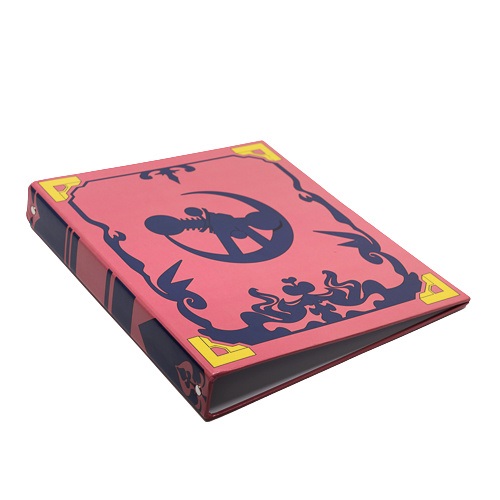
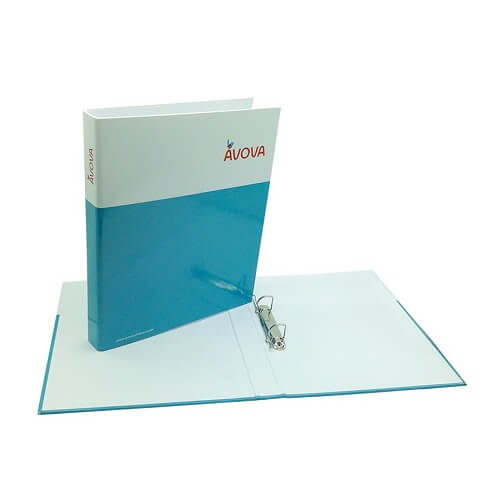
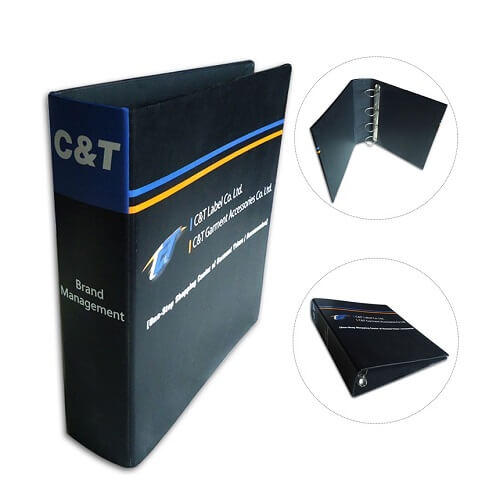
For bulk and corporate orders. Minimum order quantity and the full price list are on the ring file range page.
Before You Brief Anyone — Define the End User
A common procurement mistake is to start with “we need 500 custom files” without first answering who will use them and under what conditions. Every downstream decision — mechanism, material, printing method, colour treatment, MOQ tier — flows from the end-user profile. Before you request a quote from any supplier, write down four things:
1. Primary user: new hire, client, auditor, student, delegate, internal filer?
2. Use environment: boardroom table, training room, customer bag, compactus shelf?
3. Expected lifespan: one event, one year, or a decade of archive storage?
4. Perceived brand value required: utilitarian, standard corporate, premium executive?
Share those four answers with your supplier on day one and 80% of the subsequent decisions fall into place automatically. To see how different user profiles translate into mechanism and material choices, launch your customized file brief with Aquaholic’s procurement team.
Understanding MOQ — Why 300 Is the Singapore Standard
Ask any established Singapore custom file supplier — Aquaholic included — and the minimum order quantity for a fully branded run is 300 pieces. This is not an arbitrary number. Three fixed costs drive the MOQ floor:
1. Mechanism tooling: ring mechanisms and lever arch levers are supplied in bulk packs; splitting a pack below 300 wastes inventory and raises unit cost.
2. Printing plate setup: offset plates and silkscreen stencils carry a fixed setup cost. Below 300 units, the setup cost dominates the bill.
3. Die cutting and wrap assembly: cover die lines are cut in bulk sheets; below 300 the material waste ratio becomes uneconomical.
Above 300, the per-unit cost drops meaningfully at roughly 500, 1,000, 2,000 and 3,000 — so if your expected annual consumption is 800, consider ordering 1,000 upfront and warehousing the surplus. The storage cost is almost always lower than the price premium of running two separate smaller jobs.
Material Selection — A Quick Decision Matrix
Budget-Tight Internal Use
Semi-rigid PP or PVC ring file folder with digitally printed full-colour cover. Lowest unit cost, acceptable durability for 12-month internal life.
Standard Corporate Onboarding
Hardcover ring binder file with printed PVC wrap, 3-ring D-ring mechanism, 40 mm spine. The Singapore workhorse at MOQ 300.
Client-Facing Premium Gift
PU leatherette hardcover with foil-stamped or debossed logo, 4-ring D-ring, 40 mm spine. Projects authority at investor meetings and client kickoffs.
Long-Term Archive
Lever arch file with nickel-plated mechanism, 65–80 mm spine, printed paper or PVC wrap. Survives a decade in a compactus.
Artwork Brief Template
Hand your designer this exact specification sheet and the first proof will come back clean:
File format: PDF/X-1a, CMYK, all fonts outlined, all images embedded at 300 dpi.
Bleed: 3 mm on every outside edge of the wrap.
Safe area: 10 mm inside the trim on front/back; 12 mm on the spine.
Wrap dimensions: request the exact dieline from your supplier before starting artwork — spine width varies by mechanism.
Spine artwork: include readable department or project label; orient text so it reads bottom-to-top when the file is shelved.
Pantone colours: list any spot colours that must be matched (e.g. Pantone 2727 C, Pantone 485 C).
Finishing instructions: foil stamp position, deboss depth, spot UV coverage, lamination type (matte / gloss / soft-touch).
Proof expectation: request a physical hardcopy proof before the main production run for any order above 500 units.
Lead Time Planning — Build in Buffers
The standard production lead time for a custom file order in Singapore is 3 to 4 weeks from artwork sign-off. That window assumes CMYK artwork is already approved, Pantone matching (if any) is confirmed, and the supplier has stock of your selected mechanism. Add the following buffers to build a realistic project timeline:
+5 working days for initial artwork review and revision (assume two rounds of proof changes).
+3 working days for a physical hardcopy proof if you request one (recommended above 500 units).
+5 working days for internal stakeholder sign-off (marketing, legal, brand).
+3 working days for delivery scheduling across multiple Singapore offices.
A realistic “no drama” timeline from kick-off to delivery is therefore 5 to 6 weeks. For tender deadlines, tell us the date up front so the run can be scheduled — there is no express lane on this range.
Procurement Checklist
Paste this checklist into your internal purchase requisition so nothing slips through the cracks:
☐ End-user profile defined (primary user, environment, lifespan, brand tier).
☐ Format selected (ring file folder / ring binder file / lever arch file).
☐ Mechanism specified (2 / 3 / 4 ring, D vs O, lever arch spine size).
☐ Cover material confirmed (PVC, printed paper, leatherette, fabric).
☐ Print method agreed (digital, offset, silkscreen, foil, deboss, spot UV).
☐ Quantity at MOQ 300 minimum per SKU.
☐ Artwork supplied as PDF/X-1a with dieline, bleed and safe areas.
☐ Pantone colour matches documented.
☐ Physical hardcopy proof requested (orders above 500).
☐ Lead time confirmed with 5–6 week buffer.
☐ Delivery addresses and split quantities listed.
☐ Supplier invoice and GST documentation received.
Common Pitfalls and How to Avoid Them
Pitfall 1: Undersized spine. Buyers estimate 150 pages and order a 25 mm spine — then discover the document set grew to 220 pages. Always order one spine size larger than your best estimate.
Pitfall 2: RGB artwork. Designers working in screen-based tools submit RGB files that shift dramatically when converted to CMYK for print. Always deliver CMYK from the start and request a printed proof.
Pitfall 3: Ignoring the spine label orientation. Singapore-style archive shelves read spine text bottom-to-top; European-style reads top-to-bottom. Confirm the correct orientation with your internal archiving team before finalising artwork.
Pitfall 4: Skipping the hardcopy proof. A screen proof cannot show foil lustre, spot UV depth or deboss impression. For any order above 500 units or any run with metallic finishing, always request a physical proof.
Pitfall 5: Using a generic PO template. Generic stationery POs don’t capture mechanism type, spine size or finishing method. Build a dedicated custom-file PO template that your supplier signs off against — this prevents costly reprints.
Further Reading
Deepen your product knowledge with these companion articles: the complete ring file printing guide covers mechanisms and materials in depth; the lever arch printing guide drills into archive-grade builds; and the format comparison article helps you choose between three binder types.
Frequently Asked Questions
What is the minimum order quantity for customised files in Singapore?
The standard MOQ is 300 pieces per SKU. This applies across ring file folders, ring binder files and lever arch files.
How long does a custom file order take from start to finish?
Allow 5 to 6 weeks from kick-off to delivery once artwork revision, internal sign-off and production are all added together. Production alone runs 3 to 4 weeks from artwork sign-off.
Can I change the artwork after signing off the proof?
Changes after sign-off incur additional cost because printing plates and material sheets may already be committed. Always validate artwork against internal brand, legal and marketing stakeholders before signing off.
Are there sustainable material options?
Yes — FSC-certified paper wraps, recycled greyboard and fabric canvas wraps are available. Expect a small cost premium relative to PVC wraps, but the sustainability story strengthens your brand narrative with eco-conscious clients.
Can I split delivery across multiple Singapore offices?
Yes. Supply split quantities and delivery addresses with your purchase order. Multiple delivery points within Singapore are handled within the standard quote and don’t add lead time if addresses are confirmed at the start.
Brief Your Custom File Order With Aquaholic
Aquaholic has supplied branded ring files, ring binders and lever arch files to Singapore corporates since 2005. Send your brief using the checklist above and we’ll return a detailed quote — complete with mechanism samples, material swatches and a realistic delivery timeline — within two working days.
